
The Uncanny Artist
The Artful Life Challenge: reflections on Paula Rego's The Dance (1988)

“Artists can make the unfamiliar familiar (and vice versa). They can show us something that we instantly recognise, despite it being made in a completely different world and context to our own.” - Katy Hessel
In thinking about what makes art so unique, the above quote from Hessel immediately brings to mind the uncanny and presents interesting questions of how we are drawn to it, inspired by it, moved by its power to viscerally invoke sensations (traditionally, unease and terror). The uncanny reveals horrors hidden within mundanity, leaving us staring wide-eyed - frozen and awestruck.
The theory of the Uncanny is a topic I am all-too familiar with (an uncanny statement in itself), as it’s a central component of my PhD thesis. Briefly, the theory of “The Uncanny” was proposed by Sigmund Freud in his 1919 essay titled, “Das Unheimlich”. Translated directly from the German, das unheimlich means unhomely. However, the English translators of Freud’s essay, James and Alex Strachey, translated the term into “the uncanny” in 1925 - a term that was already being used within the field of psychoanalysis.1
Briefly, the uncanny is a disorienting phenomenological experience that echoes deja vu; it is the revelation of the unfamiliar made familiar or vice versa. The uncanny is the feeling you get in the moment when you suddenly notice a person staring straight at you - and meaning to, of thinking the person is a stranger before realising they’re your friend or vice versa (the former only a momentary feeling of unease before relief floods your body, while the latter produces sustained terror). It’s the sensation of walking through a familiar landscape, but in haar - the fog so thick that you find yourself going in circles - lost with no sense of direction or time. The uncanny is you looking in the mirror and not recognising yourself, you seeing yourself in an old painting or photo from hundreds of years ago - someone who cannot possibly be you. It’s the coincidence that feels too coincidental.
The uncanny is on the tip of your tongue, while your gut knots itself in worry; it emerges alongside the secrets that fuel it.
So, when I looked at the artwork featured for Day 2 (Jan2) of Hessel’s How to Live an Artful Life, the uncanny was, uncannily, already lying in wait. The artwork by Paula Rego titled Dance (1988) is certainly an uncanny piece. Both in terms of the finished piece and in the narrative of the artwork itself, the story behind its creation - the story it tells and the creative process it took to produce. Paula’s son, Nick Willing, acting as a stand-in model for his father - an uncanny doubling.
The painting feels very Gothic, too, in its colour palette. A house looming above the sea cliff’s edge. All cast in moonlight, and the shadow of a home looming above the scene below.
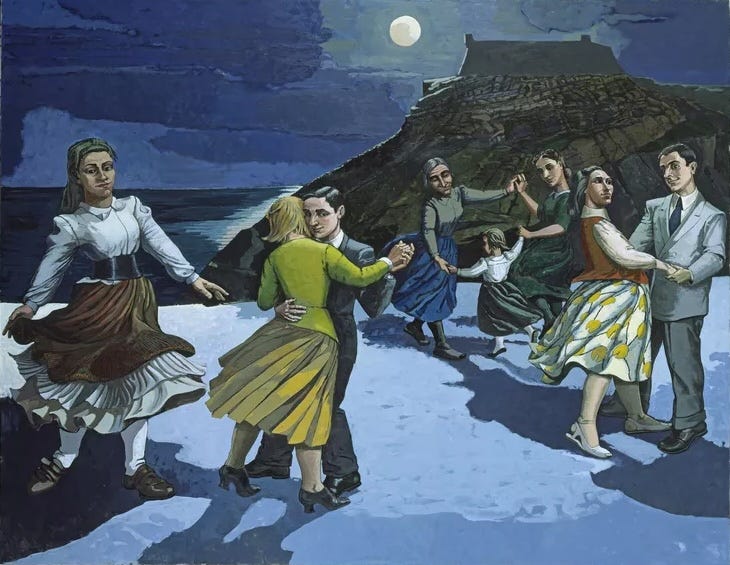
In doing additional research on the piece, I discovered that Hessel made some errors in her description of the painting.