
How to Write a Successful Academic Abstract
Featuring my easy to follow formula!

‘Tis the season! After submitting the requirements for my PhD upgrade, followed by a few days of rest, I have returned to my desk and find myself surrounded by exciting Call For Papers (CfP), all of which have deadlines within the next couple of months. One is due by the end of this week, a second in a month, and a third in just over a month after that! And so, I open up my tried and true formula for writing abstracts and get to work. It has taken me five years to perfect and simplify my approach to proposals, but abstract writing has always been one of my biggest strengths. So, over the past year, I’ve been on a mission to share my process in hopes of helping others feel more at ease and confident in sharing their research! If you want to know my secret, then keep reading…
Before you begin writing your abstract, it’s important to take the time to understand what the CfP is asking for. Firstly, you must identify the overarching theme. This tends to be fairly straightforward and is usually made explicit in the title of the conference, special issue, book, or other publication. However, do not skim over reading the descriptive overview included in the CfP, which can help you pull key questions and “buzzword” vocabulary that you can then integrate into your abstract. Usually, CfPs will include a list of topics they are specifically looking for. Therefore, determine where your research fits in relation to these, using terms in your proposal to clearly align with the specifics of the CfP. Do NOT submit a blanket abstract to numerous CfPs. Take the time to tailor your abstract to each CfP you are submitting to, even if you are presenting the same material (such as presenting the same research at two separate conferences). This does not mean addressing the organisation, journal, editors, etc. by name within the abstract, but by including similar or the same vocabulary that is used in the call for papers. Finally, be sure to make note of the word count limit.
Additionally, in the case of a conference, consider the format you want to present. Presentation formats for postgraduate students or independent researchers primarily include a paper, panel, or poster. Other formats include workshops, creative interventions/ performances, etc. So, ask yourself: What format (or formats) is the conference looking for? This will vary depending not only on the conference itself, but also on the field of study. For example, poster presentations are far more common in STEM disciplines than in the Humanities (although they are still an active format). If there are multiple options, consider which format you prefer. Do you want to stick with a format you are comfortable with? Or would you like to challenge yourself by presenting for the first time in a new format?
Top Tip: If you are submitting to multiple CfPs simultaneously, consider creating a log in Notion (or in a designated notebook) to keep track of decisions and dates. Do not overwhelm yourself by committing to more conferences or publications than you can feasibly manage! As a PhD researcher, I tend to aim for three CfP submissions in an academic year.
“But I’ve not written the paper yet!”
I’ve met many students who say they cannot submit to a CfP because they haven’t written the final paper yet. This, my friends, is entirely normal. You’d be surprised how many seasoned academics (yes, that includes your supervisors and professors) are writing their papers only a day or two before a conference. It’s also fairly normal to submit abstract proposals for journals or edited books without having written the article, chapter, etc. The exception to this is if there is a quick turnaround for publication, but this is usually noted in the CfP.
In STEM fields, it’s also common to need to “write up” the article, but the experiments (preliminary or otherwise) have already been conducted, results gathered, etc.
Document Structure
I always start an abstract by setting up the document file. If the CfP asks for a specific format, go by their requirements, but if not, this is the structure I use for abstracts that have no formatting guidelines.
Conference title/organising body and year, centred and italicised.
Theme of conference, CfP, centred and italicised - directly below the former line.
(Working) Title, left-aligned and bold - one space between the former section and this header.
Typically, I always note the title as a ‘working’ title in case I change it at the last minute. In some cases, the CfP will request a finalised title, but for the most part, journal articles and book chapter publications will assume you are presenting a working title. So, there is time to change this later on. For conference CfPs, remember that unless you update the conference committee, the title you provide in response to the CfPs is what will be listed on the programme. Use the title as an opportunity to hook your reader! Many times, the only thing that your potential audience is reading (whether choosing a panel to attend or a chapter to read) is the title! So, make it count.
Topics, left-aligned and bold - one space between the former section and this header.
As previously mentioned, a CfP will usually list examples of topics/issues that they are specifically seeking in line with the overall theme. It’s good to highlight exactly how your research meets this criterion by listing the relevant topics your paper is engaging with. If there are multiple topics that your research is relevant to, only list a maximum of three.
Abstract, left-aligned and bold - one space between the former section and this header.
Usually, anywhere between 250-400 words.
Take your time with this process. Write your abstract well, using clear language. The abstract is your ‘sales pitch’ not only for publication purposes, but in the case of a conference, abstracts (if printed in the programme) are also what entice people to attend your panel over parallel ones!
Biography, left-aligned and bold - one space between the former section and this header. Always include a brief biography of no more than 150 words, unless otherwise noted. Start the biography with your full name and include pronouns (in brackets) immediately after, if desired. You should also use bold font for your name.
Now, it’s finally time to write the abstract! The blank page is always daunting, so I’m sharing my go-to formula that I use to write my own abstracts. To start, I simply write out very basic sentences for each point in the formula. Then I revise these sentences into a coherent paragraph and edit as necessary to capture the correct tone for submission.
The Formula (for the Humanities)
1. The hook. (1 sentence) *Cut if working with a word limit of 250 words.
One sentence that will pique the interest of the reader.
2. Basic foundations and identification of the overarching theme/topic of your analysis - essentially the big picture. Include/incorporate the gap in the literature that your paper addresses. (1-2 sentences)
You’ll want to include names of specific scholars that are foundational to your framework of the topic; however, be sure to focus on defining any core vocabulary if your understanding/approach is different than the traditional meaning. If you need to define core vocabulary due to a different approach, add a sentence more to this section (no more than 3 sentences).
3. The critical framework that your paper is founded within, or rather, the general methodology you are engaging with. (1 individual sentence, or incorporated as a lead into the thesis statement)
For example, “Through the lens/mode/framework/method of…”
4. Thesis statement of the paper; your argument. (1 sentence)
For example, “I argue...”
5. Analysis. How are you examining the material and theories considered? (2-3 sentences)
For example, in the discipline of literature, you will examine a specific text, and so you want to give a brief insight into how this text reflects/approaches/engages with the thesis argument proposed. A good structure for this - in literature - is to highlight key motifs and what they reveal.
6. Point of significance. (1 individual sentence, or incorporated as a lead into a conclusive statement; an individual sentence is preferred)
In literature, note what the author or text is uniquely doing. For example, “Instead of perpetuating [X theory], [X author] encourages readers to recognise…”
7. Conclusive statement. (1 sentence)
This should reiterate the thesis and tie in the unique nature of the ‘text/material’ you examine. I like to write this in a way that, hopefully, hooks the reader as well, leaving them intrigued by the statement and wanting to know more, that is, wanting to read the full paper.
Abstracts look different across fields, but the overall formula remains fairly standard across all disciplines.
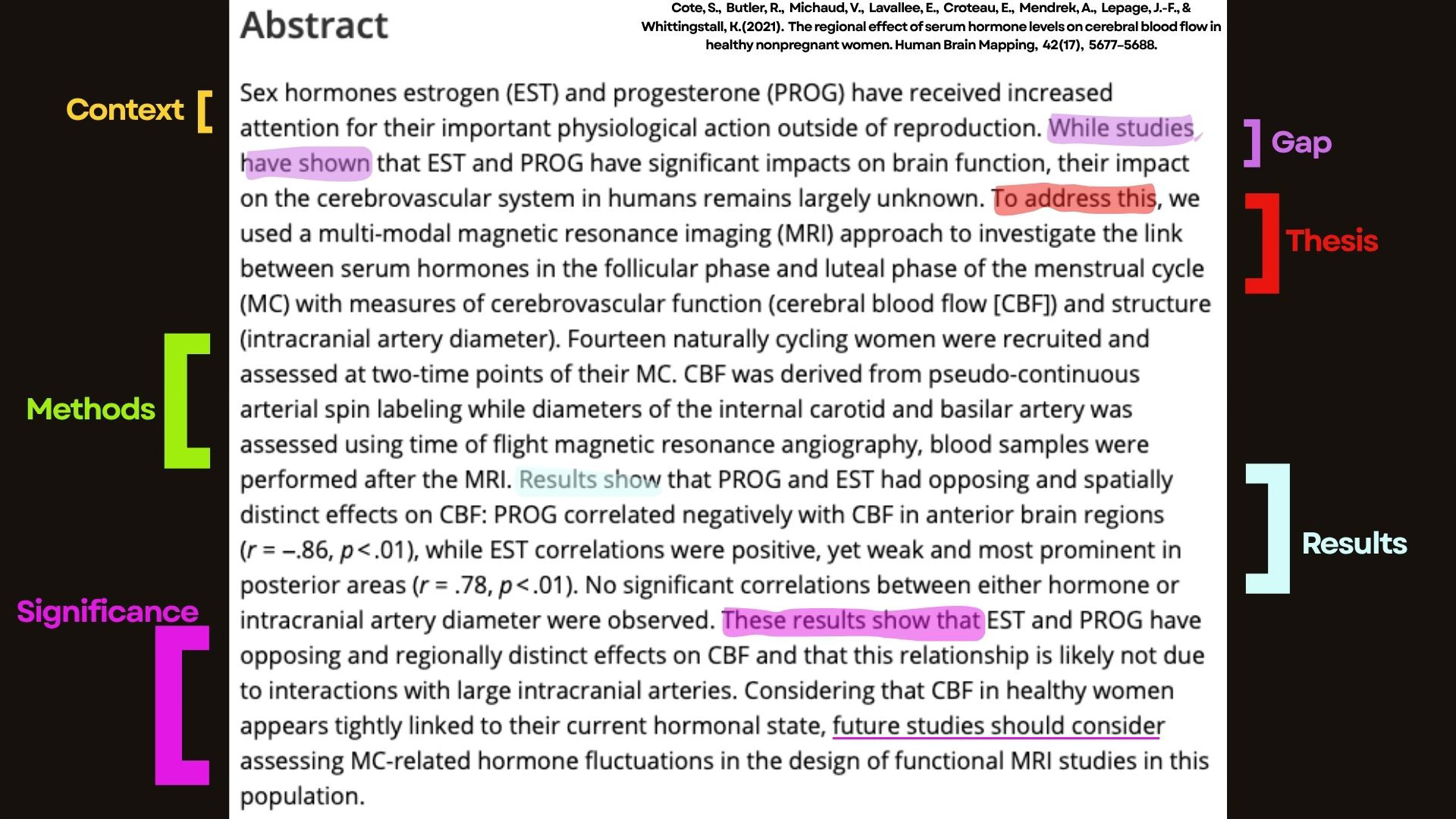
The Formula (for STEM)
Basic foundations and identification of the overarching theme/topic of your analysis; the “big picture”/context. (1-2 sentences)
Gap - why you’re conducting this study. (1 sentence)
Thesis statement of the article: your argument/objective. (1 sentence)
Methods. (2-3 sentences)
Results. (1 sentence)
Significance of results. (1-2 sentences)
Example from publication: Cote, S., Butler, R., Michaud, V., Lavallee, E., Croteau, E., Mendrek, A., Lepage, J.-F., & Whittingstall, K.(2021). The regional effect of serum hormone levels on cerebral blood flow in healthy nonpregnant women. Human Brain Mapping, 42(17), 5677–5688.
Quick Tips
Write in the present tense.
Look at abstracts in past conference programmes, if available.
If you’re unsure about the fit of your research, reach out to the CfP contact.
Keep your email inquiry concise.
Ask family or friends to read over your abstract.
Someone NOT in academia or, at the very least, not in your field. Ask them what they think your proposed paper is about.
If the deadline is too soon, reach out to the contact immediately and ask whether they will accept a late submission.
I hope you have found this post helpful. If you have any tips you’d like to share, please leave a comment so that we can all learn and support one another. I’d also love to know if you use the above formula for any upcoming CfPs. Wishing you all the very best as you hit submit!